
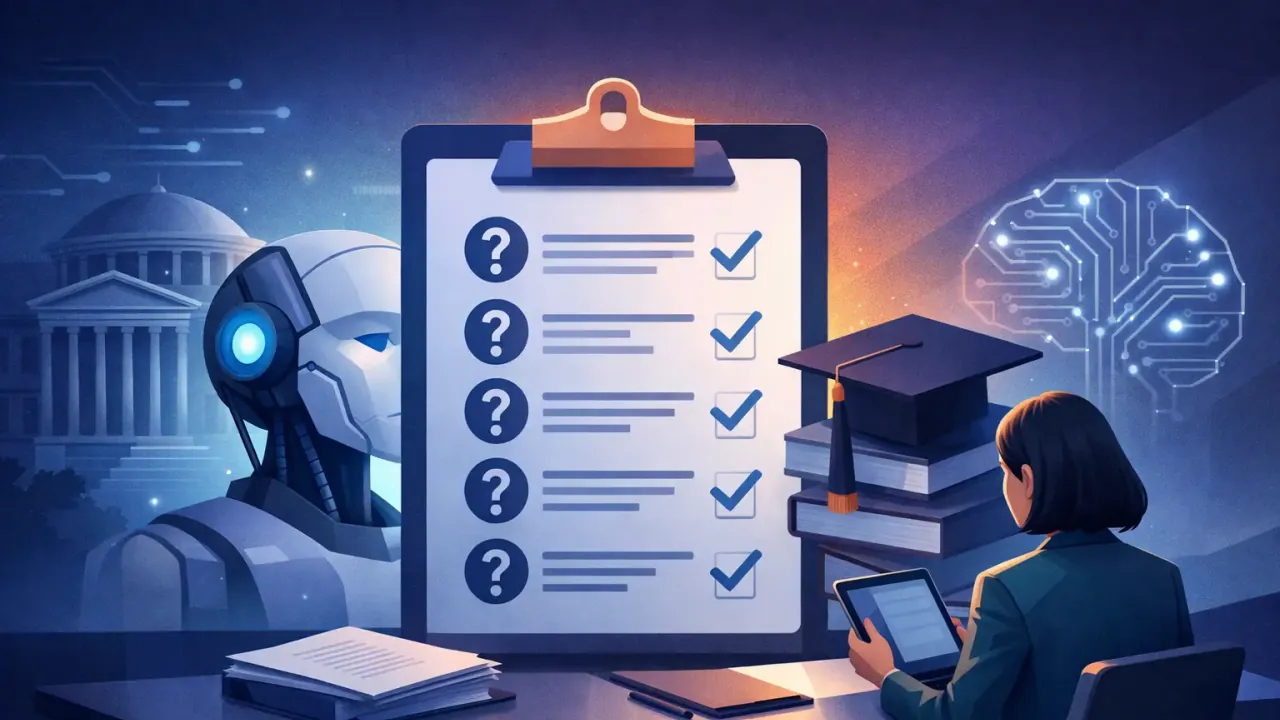
Academic AI Disclosure FAQ Template
Academic AI Disclosure FAQ Template
academic ai disclosure faq template works best when applied through a repeatable operating process instead of ad-hoc execution. Teams that standardize planning, editing, and QA usually produce stronger SEO and GEO outcomes.
This guide is written for faculty and policy teams and follows a policy clarity for students approach.
Why This Matters
Search and LLM systems reward content that is:
- Structured and clear
- Context-rich with relevant internal links
- Focused on real user decisions
Generic pages without process discipline lose visibility over time.
Practical Framework
1. Set one page objective
Define the exact decision or action the page should drive.
2. Build section logic first
Map sections around:
- Problem context
- Evaluation criteria
- Recommended solution
- Next action
3. Add specificity and constraints
Use practical details:
- Inputs
- Failure modes
- Tradeoffs
- Success criteria
4. Humanize high-impact sections
Prioritize intro, transitions, argument-heavy paragraphs, and CTA conclusion.
5. Link to relevant cluster depth
Use contextual internal links:
- transparent ai usage statement template
- ai writing disclosure rubric for faculty
- syllabus ai writing guidelines template
Workflow Sequence
Step 1: Brief
Capture audience, intent, constraints, and required entities.
Step 2: Draft
Draft for structure, then improve style and specificity.
Step 3: QA
Validate:
- Clear promise in first 120 words
- Actionable sections
- Natural internal linking
- Clear final next step
Common Mistakes
Mistake 1: Vague positioning
Pages that do not differentiate their angle are easier to replace.
Mistake 2: Orphan content
Unclustered content compiles less authority and performs weaker.
Mistake 3: Over-optimization
Forced keywords and awkward phrasing reduce trust.
Mistake 4: No cadence
Without weekly process rhythm, quality consistency drops.
Weekly Cadence
- Monday: brief + outline
- Tuesday: draft + structure pass
- Wednesday: humanization + clarity pass
- Thursday: SEO/GEO checks + links
- Friday: publish + backlog updates
FAQ
Is academic ai disclosure faq template practical for small teams?
Yes. Start with one repeatable process, one checklist, and one owner for QA decisions.
How quickly can teams see benefits?
Most teams see measurable quality and process improvements after 2-4 publish cycles.
Should teams prioritize speed or quality first?
Quality first, then scale speed with workflow standardization.
Final Checklist
- Primary keyword appears naturally in title, intro, and one H2
- Sections are practical and non-redundant
- Internal links connect to high-relevance pages
- Metadata matches intent
- Conclusion gives a concrete next step
Conclusion
academic ai disclosure faq template becomes a durable growth lever when implemented as an operating system. Apply this framework repeatedly and scale once quality stabilizes.
Topic Cluster
Academic AI Writing
Academic workflows for responsible AI-assisted writing, revision, and detector-aware editing.
Open full hubAcademic AI Writing Guide 2026: Complete Student & Researcher Manual
Pillar article
ChatGPT for Academic Writing: Bypass Detection [2026]
Supporting article
How to Bypass Turnitin AI Detection in 2026: Academic Guide
Supporting article
Can Turnitin Detect ChatGPT-4? [2026 Update]
Supporting article
AI Detection in Universities: What You Need to Know [2026]
Supporting article
Ready to Humanize Your AI Content?
Try ChatGPT Undetected and make your AI-generated content undetectable by AI detectors.
Related Posts

AI Writing Disclosure Rubric for Faculty
Use a clear rubric to evaluate AI writing disclosures and improve policy consistency across courses.

Academic AI Writing Guide 2026: Complete Student & Researcher Manual
Comprehensive guide to using AI for academic writing while maintaining integrity. Learn proper techniques, tools, and best practices for students, researcher...
Responsible AI Writing for Students: What to Do and What to Avoid
A practical student guide to responsible AI-assisted writing with transparent workflows and quality safeguards.